
The sources said Singh will carry out a comprehensive review of the security situation in the region with Gen Naravane, Northern Army Commander Lt Gen Yogesh Kumar Joshi, Commander of the 14 Corps Lt Gen Harinder Singh and other senior army officials.
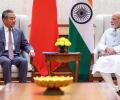
China's Foreign Minister Wang Yi expressed China's anticipation for Prime Minister Narendra Modi's visit to the Shanghai Cooperation Organisation (SCO) summit, emphasizing the importance of strong India-China relations and mutual cooperation.
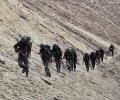
Citing media reports that China has built shelters in the Depsang area in Ladakh, the Congress on Saturday questioned the government's 'silence' over the issue and asked what steps were being taken by it to ensure status quo ante of April 2020.

The Union Budget 2025-26 had allocated Rs 2,33,210.68 crore (BE) to the ministry helmed by Union Home Minister Amit Shah.

China's ruling Communist Party is holding its annual leadership conclave to discuss the new five-year plan, the impact of US President Donald Trump's tariff war, and the ongoing anti-corruption crackdown in the military.
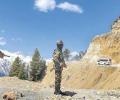
China and India have agreed to work to maintain peace along the Line of Actual Control and resolve the border standoff through talks while implementing the consensus reached between the two countries' leadership that 'differences' do not escalate into 'disputes', a top Chinese official said.
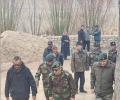
India and China agreed during their military talks on Sunday to stay in close touch and work out a mutually acceptable solution to the "remaining issues" in eastern Ladakh at the earliest, but there was no indication of clear forward movement in ending their three-year-long border standoff.
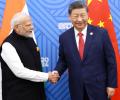
Chinese President Xi Jinping on Wednesday pledged to strengthen the strategic relationships with neighbouring countries by 'appropriately' managing differences and enhancing supply chain ties as China's tariff war with the United States escalated.

The Indian Army is looking at deploying over 350 light tanks, mostly in the mountainous border areas.
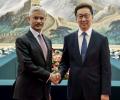
India and China should build on 'good progress' in normalising the bilateral ties to address border-related issues including de-escalation, and it is essential to avoid 'restrictive trade measures and roadblocks', External Affairs Minister S Jaishankar said on Monday during talks with his Chinese counterpart Wang Yi.

The Union Territory of Ladakh created history by successfully conducting its maiden 21-km trail running event in sub-zero temperature at 13,862 feet high Pangong Tso.

China has objected to Indian Minister Kiren Rijiju's remarks on the Dalai Lama's reincarnation, urging India to be cautious on Tibet-related issues to avoid impacting bilateral relations. China insists any future Dalai Lama must receive its approval.

China said that for a long time China has been conducting activities on its side of the Line of Actual Control and they have always complied with relevant agreements.

Prime Minister Narendra Modi and Chinese President Xi Jinping are expected to hold bilateral meetings on the sidelines of the SCO summit in Tianjin, as both nations look to strengthen ties amid global trade tensions.
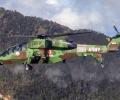
Of the 156 LCH, 90 would be for the Indian Army while 66 would be for the Indian Air Force.
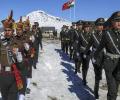
The 16th round of military talks between India and China on the lingering border standoff in eastern Ladakh will be held on July 17 on the Indian side of the Line of Actual Control (LAC) in the region, official sources said on Friday.

'We have to be prepared on the borders to withstand Chinese expansionist designs.'

"The Modi government's approach to the entire crisis could be described as DDLJ: Deny, Distract, Lie and Justify," Ramesh said.
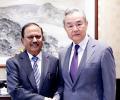
Wang is travelling to India days ahead of Prime Minister Narendra Modi's planned trip to the Chinese city of Tianjin to attend the annual summit of the Shanghai Cooperation Organisation.
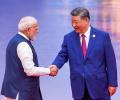
Prime Minister Narendra Modi and Chinese President Xi Jinping held talks focusing on rebuilding bilateral relations, emphasizing border peace and addressing cross-border terrorism.
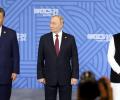
China has expressed its support for Russia's initiative to revive the Russia-India-China (RIC) troika, emphasizing its importance for regional and global security and stability.

The ministry of external affairs on Wednesday said the talks were held in an "open and constructive manner" for an early and mutually acceptable resolution of the remaining issues.

In a statement, it said compared to physically and psychologically battle-hardened Indian troops, Chinese troops mostly are from urban areas and not used to hardships or prolonged deployment under field conditions.
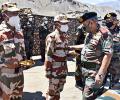
India and China should be able to achieve status quo in eastern Ladakh in a gradual manner as both sides understand that it is in the best interest of ensuring peace and tranquillity in the region, Chief of Defence Staff General Bipin Rawat said.
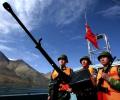
The Chinese side has particularly bolstered its presence in the Galwan Valley, erecting around 100 tents in the last two weeks and bringing in heavy equipment for construction of bunkers, notwithstanding the stiff protest by Indian troops. There have been reports of multiple incidents of transgressions by Chinese troops in several areas in Eastern Ladakh.

Singh said if there is an attempt to hurt the self-respect of India, then it will not be tolerated and will be given a 'befitting reply'. "Whatever progress has been made in the talks, there should be a resolution of the matter. But to what extent it will be resolved, I cannot guarantee."
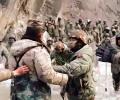
China has honored an army regiment commander who was injured in the Galwan Valley border clash with Indian soldiers in 2020 as an outstanding member of the national advisory body - Chinese People's Political Consultative Conference (CPPCC). Qi Fabao, who was made the torchbearer for the Winter Olympics in 2022, was among the 33 individuals honored with the 2024 Outstanding Performance Award for CPPCC Members. The incident, which resulted in the deaths of 20 Indian soldiers, led to a freeze in relations between the two countries for over four years. Ties were restored after a meeting between Prime Minister Narendra Modi and President Xi Jinping in October 2023.
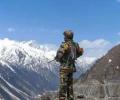
Asserting that sovereignty and territorial integrity of China are "sacred and inviolable", the country's national legislature has adopted a new law on the protection and exploitation of the land border areas, which could have bearing on Beijing's border dispute with India.

India is set to press for early disengagement of troops from the remaining friction points in eastern Ladakh at a fresh round of high-level military talks with China on August 14, people familiar with the matter said on Saturday.

In an address to the air warriors on the occasion of the 89th Air Force Day, the Chief of Air Staff also said that the IAF must demonstrate to the nation that external forces will not be allowed to violate its territory.

The commanders will also deliberate on a slew of long-pending reform measures like cutting down on ceremonial practices and non-military activities to ensure a rational distribution of resources, they said.
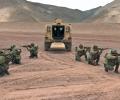
A Hyderabad-based deep-tech startup, Simpliforge Creations, has built the world's first on-site 3D-printed bunker in Leh for military use with the help of the Indian Institute of Technology Hyderabad. The project, called "Prabal," is a significant advancement in construction technology, allowing for the rapid deployment of military infrastructure in remote and challenging environments.
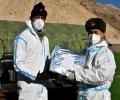
China said on Tuesday that the current situation on the border areas with India was "stable" as it confirmed that the 14th round of Corps Commander-level talks to discuss the disengagement process in the remaining friction points in eastern Ladakh will be held on Wednesday.

Palaeobotanists scouring the icy heights of Jammu and Kashmir came across a set of plant fossils near Tsokar in the Eastern Ladakh region a proof of the existence of a coastal environment in the region.

The video message that has gone viral on social media, comes within a day after Gandhi tweeted a video of the same man seen narrating a conversation with his son who recounted how he was injured in the clash with Chinese soldiers at the Line of Actual Control (LAC).

In his conversation with Prime Minister Narendra Modi, President Xi Jinping stressed that improving China-India relations serves common interests and is conducive to peace and stability of the region and the world.

The capability of operating fighter aircraft from this area would strengthen the air force's ability to tackle any misadventures by the adversary in a faster way.

Xi asked about their condition and whether they were able to "receive fresh vegetables" in the inhospitable terrain.
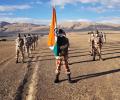
Twenty personnel of the India-China LAC guarding Indo-Tibetan Border Police (ITBP) force, who displayed bravery during the violent clashes and ongoing military standoff between the two countries in the eastern Ladakh region in May-June 2020, were on Sunday decorated with police gallantry medals.
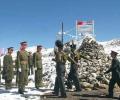
Many of them sustained minor injuries in the clash near Naku La in the Sikkim sector along the Sino-Indo border on Saturday
